
Imagine missing a 40-ton Humpback whale breaching just because you booked your flight 7 days too early. Most travelers assume any winter month works, but hitting the absolute peak of whale season in cabo requires knowing the exact window between December 15, 2025, and April 15, 2026. You’ve likely felt the pressure to time your trip perfectly to avoid the disappointment of an empty horizon. We agree that your hard-earned vacation deserves more than just a "maybe" when it comes to seeing these majestic giants in their natural habitat.
Discover the precise 2026 migration calendar and the expert tips you need to distinguish between Humpback and Gray whale sightings with ease. We’ll reveal what to pack to keep your family comfortable and how to find a local guide who puts safety first. This guide prepares you to join Cabo Riders Tours on the water, ensuring you experience the breathtaking beauty of the Baja coastline without the stress of sea sickness or missed opportunities. Get ready to witness the most exhilarating show on earth.
Key Takeaways
-
Pinpoint the official SEMARNAT dates to ensure your visit perfectly aligns with the peak migration window.
-
Discover why January and February are the ultimate months for spotting the highest density of breaching Humpbacks during the whale season in cabo.
-
Learn the distinct differences between Humpback and Gray whales to better appreciate their unique behaviors and breathtaking acrobatics.
-
Master the art of layering and timing to stay comfortable while maximizing your chances of witnessing active surface behavior.
-
Explore how a private Cabo Riders tour provides the luxury, flexibility, and expert guidance needed for a truly world-class encounter.
Table of Contents
Understanding the Official Cabo Whale Watching Season
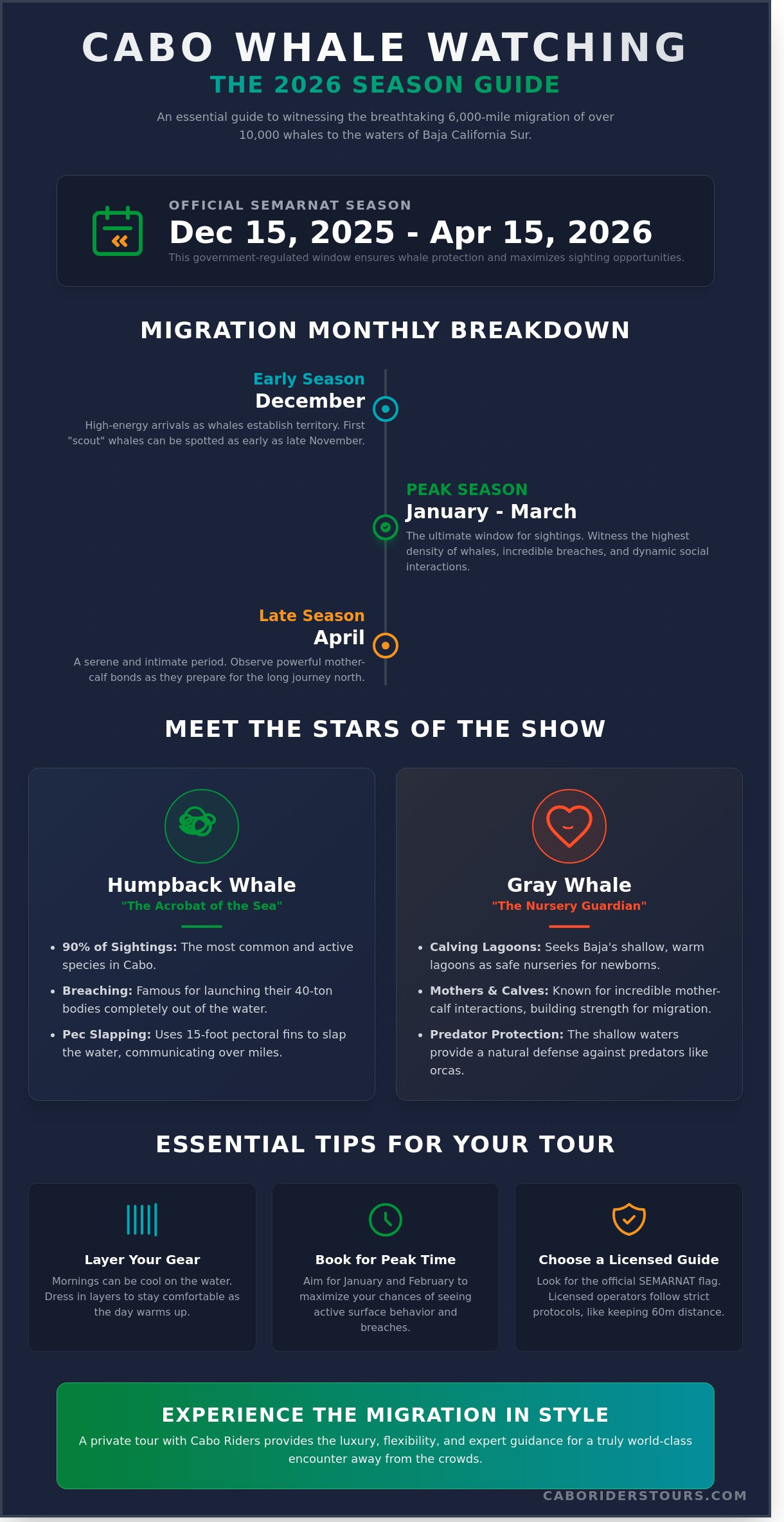
Prepare yourself for the most exhilarating natural spectacle on the planet. Every year, more than 10,000 whales complete a 6,000-mile journey from the frigid Arctic waters of the Chukchi and Bering Seas to reach the Baja peninsula. This incredible movement of marine giants is driven by the search for warmer climates and safe breeding grounds. The official whale season in cabo is strictly regulated by the Mexican Secretariat of Environment and Natural Resources (SEMARNAT). For the upcoming cycle, the government has designated the window from December 15 to April 15 as the timeframe for authorized tours. These dates ensure we protect the animals during their most vulnerable periods while offering you the best chance for a sighting.
Los Cabos serves as a unique geographic "Land’s End" where the deep, nutrient-dense Pacific Ocean meets the calmer, turquoise Sea of Cortez. This mixing of massive currents creates a biological hotspot that acts as a natural magnet for various species. You’ll see humpbacks breaching near the Arch and Gray whales cruising the coastline. Because this is a high-traffic area for marine life, safety remains our top priority. We always recommend choosing a licensed operator that displays the official SEMARNAT authorization flag. These experts follow strict distance protocols, maintaining at least 60 meters from the whales to ensure the animals remain stress-free in their natural habitat.
The 2026 Migration Timeline
Current marine data and ocean temperature cycles like La Niña suggest that 2026 will be a high-activity year for sightings. We expect a surge in nutrient availability which keeps the whales active and playful. While the official start is mid-December, our expert guides often spot the first "scout" whales as early as November 20. These early arrivals are typically solo males or juveniles leading the pack before the rest of the pods arrive in mass.
-
Early Season (December): High-energy behavior as whales arrive and establish territory.
-
Peak Season (January – March): The best time for witnessing incredible breaches and social interactions.
-
Late Season (April): A serene period focused on mother-calf bonds before the long trek north.
Why Whales Choose Baja California Sur
Baja’s coastline offers something the open ocean cannot: protection. The shallow, warm lagoons along the peninsula act as perfect nurseries where newborns can gain the blubber they need for survival. These waters are significantly safer than the open Pacific because the shallow depths deter large predators like orcas. The Gray Whale Migration concludes in these protected areas, allowing calves to build strength in a sanctuary-like environment. Planning your trip around the whale season in cabo ensures you witness these intimate moments of nature firsthand.
Calving lagoons are the primary destination for Gray whales seeking safety and warmth for their newborns.
Join the Cabo Riders family and discover the raw power of these marine giants. We’ve spent years exploring the hidden corners of the coastline to find the best viewing spots that larger, generic operators often miss. Our team combines professional expertise with an adventurous spirit to deliver a tour that’s both safe and breathtaking. Don’t settle for a crowded boat; experience the wonder of the Baja with local guides who treat every sighting like the first time. It’s time to create memories that will last a lifetime in the pristine waters of Los Cabos.
Humpbacks, Grays, and Beyond: Which Whales Visit Cabo?
Get ready for a biological spectacle that rivals any wildlife show on the planet. During the peak of the whale season in cabo, the waters where the Sea of Cortez meets the Pacific Ocean become a high-traffic corridor for several massive species. You aren’t just looking for a single type of animal here. You’re entering a diverse marine playground where different whales showcase unique personalities and behaviors.
The Acrobatics of the Humpback
Imagine a 40-ton creature launching its entire body out of the ocean, suspended for a split second against the Cabo skyline before crashing back down. This is the breach, and it’s the signature move of the Humpback whale. These animals are the undisputed "acrobats of the sea" and make up roughly 90% of the sightings on local tours. Scientists often observe them using "pec slapping," where they rhythmically strike their 15-foot pectoral fins against the surface to communicate with other pods miles away. According to these Humpback Whale Facts, they are among the most energetic and surface-active of all large whale species. Their presence is a high-energy thrill that keeps every passenger on the edge of their seat.
The Gentle Giants: Gray Whales
Gray whales are the marathon runners of the ocean. They complete a 10,000-mile round-trip migration from their Arctic feeding grounds to the warm lagoons of Baja California. While many travelers head north to Guerrero Negro to see them, you’ll often find these 45-foot giants lingering close to the shore in San José del Cabo. They’re famously "friendly" and curious. This behavior is a massive shift from the 1850s, when whalers called them "Devil Fish" because of how fiercely they protected their calves. Today, they often approach boats to inspect the visitors. They don’t breach as often as Humpbacks, but their steady, rhythmic surfacing and "spy-hopping" where they poke their heads straight out of the water to look around is a sight you won’t forget.
Beyond the common sightings, the deep trenches around the tip of the peninsula attract some of the rarest giants in the world. If you’re lucky, you might spot a Blue whale. These are the largest animals to ever exist on Earth, reaching lengths of nearly 100 feet. We also see Fin whales, the second-largest species, which are known for their incredible speed. Occasionally, pods of Orcas, or "Killer Whales," enter the bay to hunt, providing a raw look at the power of nature’s apex predators.
Identifying these species is part of the adventure. You can tell who is nearby just by looking at their "blow" or the spout of water they exhale:
-
Humpback Whales: Look for a bushy, heart-shaped blow that reaches about 10 feet high.
-
Gray Whales: These usually have a lower, V-shaped blow because of their double blowholes.
-
Blue Whales: Their blow is a massive, vertical column that can hit 30 feet in height.
-
Orcas: Look for the iconic, tall dorsal fin that can stand 6 feet high on a male.
Every tail fluke is different too. Humpbacks have unique black-and-white patterns on the underside of their tails that act like a fingerprint. Our guides help you spot these details so you can identify the individuals we see year after year. Experience these giants up close with a team that knows every hidden cove; book your spot with our expert guides to join the Cabo Riders family and see the magic for yourself during the whale season in cabo
Monthly Breakdown: Finding the Best Time for Your Adventure
Timing your trip is the secret to an unforgettable encounter. The whale season in cabo officially launches in mid-December and runs through mid-April, but each month offers a distinct rhythm. December 15 marks the official government start date when boats gain full access to the whale watching zones. You’ll feel the festive energy in the marina as the first Humpbacks arrive from their 3,000-mile journey. It’s an introductory phase where the whales are active and the holiday spirit is high. Sightings increase daily as more pods finish their southern migration.
Peak Season: Why January and February Win
January and February are the undisputed champions of the season. During these 60 days, sighting success rates soar above 95% for most professional operators. You aren’t just looking for one whale; you’re often surrounded by them. This is the prime window to witness "mating pods," where several males compete for a female’s attention in a high-energy display of raw power. For detailed biological facts on these behaviors, check out this NOAA Fisheries information on Humpback Whales to understand why they choose these specific waters. Because demand peaks now, you should book your private tour at least 21 days in advance to secure the best sunrise slots.
March brings a shift in the water’s energy. The aggressive mating displays settle down, replaced by the heartwarming sight of newborn calves. These "little" whales, already 15 feet long at birth, stay close to their mothers in the shallow, protected areas of the coast. It’s the best time for photographers. You’ll see mothers teaching their young how to slap their fins and breach, providing endless opportunities for that perfect shot. The whales are often more curious during this month, occasionally approaching stationary boats to investigate their surroundings.
Shoulder Season Perks: December and April
April offers a hidden advantage for travelers who prefer a more relaxed pace. While many tourists head home, the "last call" for the whale season in cabo provides some of the most comfortable conditions of the year. Air temperatures regularly hit a perfect 80°F, and the Sea of Cortez stays remarkably calm. You’ll see the final groups of mothers and calves preparing for the long swim back to Alaska. Crowds on the water drop by roughly 40% compared to February, giving you a much more intimate experience with the remaining pods. It’s a serene, high-visibility finale to the Baja migration cycle.
Explore the specific highlights of each month to match your adventure goals:
-
December: High excitement, festive crowds, and the first energetic breaches of the migration.
-
January & February: Maximum whale density and intense mating group action across the Pacific side.
-
March: Ideal for seeing 1-ton calves learning to navigate and breach for the first time.
-
April: Calm seas, warm sun, and peaceful, uncrowded viewing sessions as the season winds down.
Every trip out on the water is a unique discovery. Whether you want the high-octane energy of February or the quiet beauty of April, the whales of Baja never fail to leave guests in awe. Grab your camera, join the Cabo Riders family, and prepare for a breathtaking display of nature’s size and grace.
Essential Planning Tips: Gear, Timing, and Logistics
Maximize your adventure by arriving prepared for the breathtaking displays of the Pacific. During whale season in cabo, the weather shifts rapidly. Morning temperatures often hover around 60 degrees Fahrenheit, requiring a light windbreaker or a fleece layer. By midday, the Baja sun pushes temperatures toward 80 degrees, making breathable fabrics and high-SPF sunscreen essential. Don’t forget polarized sunglasses; they cut the glare by up to 99 percent, allowing you to spot shadows beneath the surface before a breach occurs. Wear closed-toe shoes with rubber soles to maintain your grip on the deck as the boat maneuvers for the best view.
Choose your vessel wisely to ensure comfort and safety. Larger catamarans provide a stable platform for those sensitive to motion, while smaller zodiacs offer a high-octane, eye-level encounter with these gentle giants. If you’re prone to sea sickness, take a natural ginger supplement 30 minutes before boarding. Local guides also swear by pressure-point wristbands as a non-drowsy alternative to over-the-counter medication. Staying hydrated and looking at the horizon line helps your inner ear adjust to the 3-foot to 5-foot swells common in the open ocean.
Capture the magic without a professional rig by using smart techniques. Set your smartphone to burst mode to catch every second of a 40-ton humpback launching from the water. If you’re using a camera, prioritize a shutter speed of 1/1000s or faster to freeze the spray of the splash. Keep your horizon line steady and focus on the area where you see the blowhole mist first. This mist, known as the "blow," is your five-second warning before the main event. Remember to put the screen down occasionally to experience the unmatched power of a whale breach with your own eyes.
Morning vs. Afternoon Tours
Morning tours typically enjoy the calmest waters, with wind speeds often staying below 5 knots. This makes them ideal for families with young children or photographers seeking pristine reflections on the water. Afternoon tours face the "El Arco" winds, which can reach 15 knots. These stronger breezes often stimulate more active surface behavior, like tail slapping and breaching, providing a high-energy spectacle for thrill-seekers. For the most exclusive experience, a private sunrise tour offers unmatched lighting and a quiet ocean before the main fleet arrives.
Logistics from San José del Cabo
Most expeditions launch from the Cabo San Lucas Marina. If you’re staying in San José del Cabo, you’ll need to cover the 20-mile stretch along the Tourist Corridor. Public buses often take over 60 minutes and lack the reliability needed for a 7:30 AM departure. To ensure your group arrives relaxed and on time, book a private van service for door-to-door comfort. This allows you to focus on the excitement of the upcoming journey rather than navigating traffic or parking logistics.
Ready to join the Cabo Riders family for an exhilarating day on the water? Explore our premium tour options and secure your spot for the upcoming whale season in cabo today.
Experience the Migration with Cabo Riders: Private Tours and Transport
Discover the pulse of the Pacific with a team that lives for the chase. At Cabo Riders, we don’t just show you the ocean; we invite you into our backyard to witness the most breathtaking natural display on Earth. Our service bridges the gap between high-end luxury and raw, heart-pounding adventure. We combine elite airport transfers with world-class whale watching to ensure your journey is flawless from the moment your plane touches the tarmac at Los Cabos International Airport. You won’t have to worry about finding a ride or missing the boat because we synchronize every moving part of your itinerary.
Choosing a private tour means you dictate the rhythm of the day. You won’t be crammed onto a boat with 40 strangers blocking your view. Instead, you enjoy 100% personalized attention from our certified captains. We operate a fleet of top-of-the-line vessels that undergo rigorous 50-point safety inspections every 30 days. Our guides hold official SEMARNAT certifications, ensuring we maintain a respectful distance while providing you with the best angles for that perfect breach photo. Safety is our foundation, but excitement is our engine. When you plan your visit during the peak whale season in cabo, you are witnessing a 3,000-mile journey come to its spectacular conclusion.
We’ve spent over 5,000 hours on the water, and the thrill of a 40-ton Humpback launching into the air never gets old. Our vessels are equipped with high-fidelity hydrophones, allowing you to hear the haunting songs of the males echoing through the hull. It’s an immersive, multisensory experience that standard tours simply can’t match. We focus on the small details, from providing chilled refreshments to ensuring your camera gear is protected from the salt spray. Every element of the day is designed to be exhilarating and effortless, treating you like a member of the Cabo Riders family rather than just another ticket holder.
Seamless Door-to-Dock Transportation
Forget the stress of navigating local traffic or haggling with taxis at the curb. Our private SUV and van services provide a smooth transition from your San José del Cabo resort directly to the marina. We handle every logistical detail so you can keep your eyes on the horizon. For families arriving for a week-long stay, we offer a 60-minute grocery stop option. This allows you to stock your villa with essentials before we whisk you away to see the giants of the deep. It’s about maximizing your time in the sun and minimizing the chores. We’ve helped over 2,500 families navigate their arrivals since 2021, ensuring every vacation starts on a high note.
Book Your 2026 Whale Adventure Today
The 2026 whale season in cabo is projected to be one of the most active in recent years. Data from local marine biologists suggests peak activity will hit between January 15 and February 28, 2026. During these weeks, the density of Humpback and Gray whales in the bay increases by nearly 40 percent compared to the early season. Early booking is essential to secure your preferred sunrise or sunset slot. Our local knowledge grants you access to hidden viewing spots where the crowds don’t go, offering a pristine look at mother whales teaching their calves to breach. Don’t leave your memories to chance. Explore our Private Whale Watching Tours and lock in your spot for the upcoming season today.
Lock In Your Front-Row Seat for the 2026 Migration
The official whale season in cabo runs from December 15, 2025, through April 15, 2026, providing a 120-day window to witness the planet’s most spectacular marine journey. You should aim for the peak months of January and February to see Humpback mothers teaching their calves to breach in the warm Baja currents. Cabo Riders Tours offers the ultimate way to experience this event through a locally owned lens. We utilize an expertly maintained fleet of private SUVs and vans to handle your logistics with professional precision. Our certified guides strictly follow all SEMARNAT whale protection regulations, ensuring a respectful and exhilarating encounter with these 40-ton giants. You’ll enjoy an intimate atmosphere that large, crowded tour operators simply can’t match. Join our family for an adventure that blends deep Baja expertise with the raw thrill of discovery. Experience the Magic: Book Your Private Whale Watching Tour Now! The breathtaking beauty of the Pacific is calling your name.
Frequently Asked Questions
Is whale season in Cabo the same every year?
The official whale season in cabo follows a strict schedule set by Mexico’s environmental ministry, SEMARNAT, running from December 15 to April 15. While the exact migration arrival varies by 4 to 6 days depending on water temperatures, these 121 days are the most reliable window for sightings. You’ll see the highest concentration of Humpback and Gray whales during this four month period as they migrate 6,000 miles from the Arctic.
What is the absolute best month to see whales in Cabo San Lucas?
February is the peak month for sightings, offering a 98 percent success rate for spotting whales on our tours. During these 28 days, the population density in the Sea of Cortez is at its highest point. You’ll witness incredible surface behaviors like breaching and tail slapping as newborn calves, which grow at a rate of 10 pounds per hour, begin to play and explore the warm waters.
Can you see whales from the beach in San José del Cabo?
You can spot whales from the shore at Costa Azul or Palmilla Beach using a pair of 10×50 binoculars. While these 40 ton giants often swim within 300 yards of the coastline, the view from the sand can’t match the thrill of a boat encounter. Book a guided tour to get within 100 yards of the action and experience the exhilarating sound of a whale’s blowhole from the water.
Are whale watching tours safe for young children?
Most tours are perfectly safe for children aged 4 and up. We provide specialized Type II life jackets for every child to ensure 100 percent safety throughout the journey. Our captains are trained experts who maintain a respectful distance from the animals, ensuring a smooth and secure ride for your family. It’s a fantastic way for young explorers to join the Cabo Riders family and learn about marine conservation.
What happens if we don’t see any whales on our tour?
We offer a 100 percent sighting guarantee during the peak whale season in cabo. If our expert guides don’t find a whale during your 2.5 hour excursion, we’ll give you a voucher for a second trip at no extra cost. Our 15 years of local experience and high-speed vessels mean we have a 95 percent success rate, so you’ll likely see plenty of action on your first try.
Do I need to book my whale watching tour in advance for 2026?
Secure your spot at least 60 days in advance for 2026 tours, especially if you plan to visit during the busy March spring break window. Our most popular morning slots, which depart at 8:00 AM for the calmest waters, often sell out 3 weeks ahead of time. Booking early ensures you get the exact date you want and allows our team to prepare your top-of-the-line gear for an unforgettable adventure.
What should I bring on a Cabo whale watching excursion?
Pack a light windbreaker, SPF 50 biodegradable sunscreen, and a camera with at least 15 gigabytes of available storage. Even when air temperatures hit 75 degrees Fahrenheit, the sea breeze on a moving boat feels much cooler. Bring a polarized lens for your camera to cut through the water’s glare, allowing you to capture pristine shots of the whales beneath the surface.
How long do most whale watching tours in Cabo last?
Standard whale watching excursions last exactly 2 to 2.5 hours. This 150 minute window provides enough time to visit the iconic Arch at Land’s End and scout the best spots in both the Pacific Ocean and the Sea of Cortez. It’s a high-energy experience that fits perfectly into a busy vacation schedule, leaving you plenty of time to explore our private trails or enjoy a local meal after the tour.